Medical Marijuana Card and Gun Laws: Complete 2026 Guide
A medical marijuana card allows qualified patients in the United States to legally access cannabis under state medical programs. However, firearm ownership laws operate under a separate federal system, creating confusion for many patients.
This guide explains how an MMJ card affects gun ownership in 2026, how federal law applies, and what changes from state to state.
What Is a Medical Marijuana Card?
A medical marijuana card is a state-issued identification that allows patients with qualifying conditions to legally purchase and use cannabis from licensed dispensaries.
To qualify, most states require:
- State residency
- Physician certification
- A qualifying medical condition
- Registration in the state medical marijuana program
Once approved, patients can legally purchase regulated cannabis products within their state.
Medical Marijuana Card and Gun Ownership: How It Works
The relationship between a medical marijuana card and firearm ownership is governed primarily by federal law in the United States.
Federal Law (United States)
Under the federal Gun Control Act (18 U.S.C. § 922(g)(3)), restrictions exist for unlawful users of controlled substances. Marijuana remains a Schedule I controlled substance under federal law.
However, on June 18, 2026, the U.S. Supreme Court ruled in U.S. v. Hemani that the government cannot automatically deny Second Amendment protections to a person solely because they use marijuana. The decision significantly limits the broad application of federal firearm restrictions to marijuana users.
Writing for the majority, Justice Neil Gorsuch pointed out the government’s logical error, noting that under a broad interpretation of an “unlawful user,” a husband who occasionally takes his spouse’s prescription Ambien to sleep, or a college student sharing an Adderall to study, could technically face federal felony charges. “To state the analogy,” Gorsuch wrote, “is to expose its deficiency.”
Federal firearm transactions and background checks are still governed by federal law, but the legal landscape surrounding marijuana users and gun ownership continues to evolve.
ATF Form 4473 and Gun Purchases
When purchasing a firearm from a federally licensed dealer, applicants must complete ATF Form 4473 (ATF Firearms Forms).
This form requires disclosure of marijuana or other controlled substance use.
Because marijuana remains federally illegal:
- Federal firearm transactions are still governed by federal law
- ATF Form 4473 continues to ask about unlawful use of controlled substances
- The legal impact of marijuana use on firearm eligibility may continue to evolve following the Supreme Court’s 2026 decision
Does a Medical Marijuana Card Remove Gun Rights?
No. It does NOT automatically remove firearm ownership rights.
State laws generally do not revoke firearm rights simply because a person is a medical marijuana patient. Following the Supreme Court’s 2026 Hemani decision, marijuana use alone is no longer automatically considered sufficient reason to deny Second Amendment protections.
However, firearm laws remain subject to ongoing federal regulations and legal interpretation.
State-by-State Impact of an MMJ Card and Gun Laws
Gun laws vary by state, but federal law applies nationwide for firearm purchases.
Arkansas
- Medical marijuana is legal for qualified patients
- No automatic firearm confiscation for cardholders
- Federal firearm rules still apply for purchases
- Background checks follow federal standards
A medical marijuana card does not remove gun ownership rights but may affect purchases.
Oklahoma
- Medical marijuana is legal for both new and existing patients
- State law does not prohibit firearm ownership for cardholders
- Federal law still governs firearm background checks
Patients with an MMJ card remain subject to federal restrictions during gun purchases.
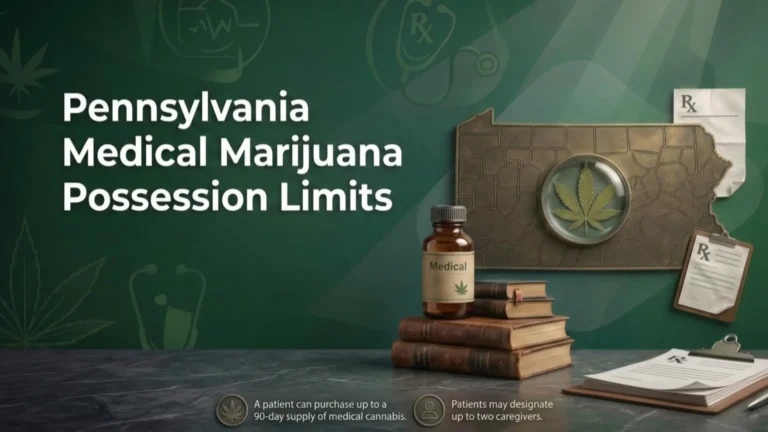
Pennsylvania
- Medical marijuana is legal for approved patients
- No automatic firearm seizure for cardholders
- Federal law may restrict firearm purchases
- Background checks follow NICS system
A medical marijuana card does not revoke gun rights but may affect purchase eligibility under federal law.
Can You Be Denied a Gun Purchase With a Medical Marijuana Card?
Possibly.
The Supreme Court’s 2026 decision changed how federal firearm restrictions may be applied to marijuana users. Marijuana use alone is no longer automatically considered sufficient to deny a person’s Second Amendment rights.
However, federal firearm laws remain in effect, and agencies, courts, and firearm dealers may continue adjusting their policies and procedures as the ruling is implemented.
Does the Government Track Medical Marijuana Patients?
- State medical marijuana programs do NOT directly share patient lists with firearm databases
- Firearm eligibility is determined at the time of purchase through federal systems
- There is no automatic cross-check between medical registries and cannabis programs
Why Do Patients Still Get a Medical Marijuana Card?
Despite firearm restrictions, many patients choose an MMJ card for legal access to cannabis for conditions such as:
- Chronic pain
- PTSD
- Anxiety
- Epilepsy
- Cancer-related symptoms
- Sleep disorders
Medical programs ensure safe, regulated, and tested cannabis products.
How to Get an MMJ Card?
Step 1: State Registration
Create an account with your state medical marijuana program.
Step 2: Physician Evaluation
Meet with a licensed medical marijuana doctor for certification.
Step 3: Approval
Once approved, you are added to the state registry.
Step 4: Receive Your Card
Your medical marijuana card allows legal purchase from dispensaries.
Why Patients Choose Ozark MMJ Cards
Patients choose Ozark MMJ Cards for a simple and supportive process.
We provide:
- Cheap and Affordable Online MMJ Doctor Evaluations
- Fast eligibility screening
- State-compliant certification
- Step-by-step guidance
- Patient support throughout the process
You can begin your evaluation by selecting your state below:
- Start your evaluation in Arkansas → Book Arkansas Appointment
- Start your evaluation in Oklahoma → Book Oklahoma Appointment
- Start your evaluation in Pennsylvania → Book Pennsylvania Appointment
Our goal is to make getting a medical marijuana card easy, legal, affordable, and stress-free.
Final Summary
A Medical Marijuana Card provides legal access to cannabis under state law, while firearm laws continue to involve both state and federal regulations.
In June 2026, the U.S. Supreme Court ruled that marijuana use alone is not enough to automatically strip a person of their gun rights. While federal marijuana laws remain in place, the decision significantly changed how firearm restrictions may be applied to marijuana users.
Patients should stay informed as federal and state laws continue to evolve.
Frequently Asked Questions
Can you own a gun with a Medical Marijuana Card?
The legal landscape changed significantly in 2026. The Supreme Court ruled that marijuana use alone is not enough to automatically strip a person of Second Amendment protections.
Does an MMJ card show up on background checks?
Not directly, but firearm eligibility is determined through federal systems.
Can you be denied a firearm if you use medical marijuana?
Possibly. The law is evolving following the Supreme Court’s 2026 ruling, and firearm eligibility may depend on individual circumstances and future legal guidance.
Is medical marijuana legal in the U.S.?
Yes, in many states, but it remains federally illegal.